skip to main |
skip to sidebar
Normal Human Occlusion
In 1967, a team of geneticists and anthropologists published an extensive study of a population of Brazilian hunter-gatherers called the Xavante (1). They made a large number of physical measurements, including of the skull and jaws. Of 146 Xavante examined, 95% had "ideal" occlusion, while the 5% with malocclusion had nothing more than mild crowding of the incisors (front teeth). The authors wrote: Characteristically, the Xavante adults exhibited broad dental arches, almost perfectly aligned teeth, end-to-end bite, and extensive dental attrition [tooth wear].
In the same paper, the author presents occlusion statistics for three other cultures. According to the papers he cites, in Japan, the prevalence of malocclusion was 59%, and in the US (Utah), it was 64%. He also mentions another native group living near the Xavante, part of the Bakairi tribe, living at a government post and presumably eating processed food. The prevalence of malocclusion was 45% in this group.
In 1998, Dr. Brian Palmer (DDS) published a paper describing some of the collections of historical skulls he had examined over the years (2): ...I reviewed an additional twenty prehistoric skulls, some dated at 70,000 years old and stored in the Anthropology Department at the University of Kansas. Those skulls also exhibited positive [good] occlusions, minimal decay, broad hard palates, and "U-shaped" arches.
The final evaluations were of 370 skulls preserved at the Smithsonian Institution in Washington, D.C. The skulls were those of prehistoric North American plains Indians and more contemporary American skulls dating from the 1920s to 1940s. The prehistoric skulls exhibited the same features as mentioned above, whereas a significant destruction and collapse of the oral cavity were evident in the collection of the more recent skulls. Many of these more recent skulls revealed severe periodontal disease, malocclusions, missing teeth, and some dentures. This was not the case in the skulls from the prehistoric periods...
The arch is the part of the upper jaw inside the "U" formed by the teeth. Narrow dental arches are a characteristic feature of malocclusion-prone societies. The importance of arch development is something that I'll be coming back to repeatedly. Dr. Palmer's paper includes the following example of prehistoric (L) and modern (R) arches:
 Dr. Palmer used an extreme example of a modern arch to illustrate his point, however, arches of this width are not uncommon today. Milder forms of this narrowing affect the majority of the population in industrial nations.
In 1962, Dr. D.H. Goose published a study of 403 British skulls from four historical periods: Romano-British, Saxon, medieval and modern (3). He found that the arches of modern skulls were less broad than at any previous time in history. This followed an earlier study showing that modern British skulls had more frequent malocclusion than historical skulls (4). Goose stated that:
Although irregularities of the teeth can occur in earlier populations, for example in the Saxon skulls studied by Smyth (1934), the narrowing of the palate seems to have occurred in too short a period to be an evolutionary change. Hooton (1946) thinks it is a speeding up of an already long standing change under conditions of city life.
Dr. Robert Corruccini published several papers documenting narrowed arches in one generation of dietary change, or in genetically similar populations living rural or urban lifestyles (reviewed in reference #5). One was a study of Caucasians in Kentucky, in which a change from a traditional subsistence diet to modern industrial food habits accompanied a marked narrowing of arches and increase in malocclusion in one generation. Another study examined older and younger generations of Pima Native Americans, which again showed a reduction in arch width in one generation. A third compared rural and urban Indians living in the vicinity of Chandigarh, showing marked differences in arch breadth and the prevalence of malocclusion between the two genetically similar populations. Corruccini states:In Chandigarh, processed food predominates, while in the country coarse millet and locally grown vegetables are staples. Raw sugar cane is widely chewed for enjoyment rurally [interestingly, the rural group had the lowest incidence of tooth decay], and in the country dental care is lacking, being replaced by chewing on acacia boughs which clean the teeth and are considered medicinal.
Dr. Weston Price came to the same conclusion examining prehistoric skulls from South America, Australia and New Zealand, as well as their living counterparts throughout the world that had adhered to traditional cultures and foodways. From Nutrition and Physical Degeneration: In a study of several hundred skulls taken from the burial mounds of southern Florida, the incidence of tooth decay was so low as to constitute an immunity of apparently one hundred per cent, since in several hundred skulls not a single tooth was found to have been attacked by tooth decay. Dental arch deformity and the typical change in facial form due to an inadequate nutrition were also completely absent, all dental arches having a form and interdental relationship [occlusion] such as to bring them into the classification of normal.
Price found that the modern descendants of this culture, eating processed food, suffered from malocclusion and narrow arches, while another group from the same culture living traditionally did not. Here's one of Dr. Price's images from Nutrition and Physical Degeneration (p. 212). This skull is from a prehistoric New Zealand Maori hunter-gatherer:
 Note the well-formed third molars (wisdom teeth) in both of the prehistoric skulls I've posted. These people had ample room for them in their broad arches. Third molar crowding is a mild form of modern face/jaw deformity, and affects the majority of modern populations. It's the reason people have their wisdom teeth removed. Urban Nigerians in Lagos have 10 times more third molar crowding than rural Nigerians in the same state (10.7% of molars vs. 1.1%, reference #6).
Straight teeth and good occlusion are the human evolutionary norm. They're also accompanied by a wide dental arch and ample room for third molars in many traditionally-living cultures. The combination of narrow arches, malocclusion, third molar crowding, small or absent sinuses, and a characteristic underdevelopment of the middle third of the face, are part of a developmental syndrome that predominantly afflicts industrially living cultures.(1) Am. J. Hum. Genet. 19(4):543. 1967. (free full text)(2) J. Hum. Lact. 14(2):93. 1998(3) Arch. Oral Biol. 7:343. 1962(4) Brash, J.C.: The Aetiology of Irregularity and Malocclusion of the Teeth. Dental Board of the United Kingdom, London, 1929.(5) Am J. Orthod. 86(5):419
(6) Odonto-Stomatologie Tropicale. 90:25. (free full text)
Normal Human Occlusion
In 1967, a team of geneticists and anthropologists published an extensive study of a population of Brazilian hunter-gatherers called the Xavante (1). They made a large number of physical measurements, including of the skull and jaws. Of 146 Xavante examined, 95% had "ideal" occlusion, while the 5% with malocclusion had nothing more than mild crowding of the incisors (front teeth). The authors wrote: Characteristically, the Xavante adults exhibited broad dental arches, almost perfectly aligned teeth, end-to-end bite, and extensive dental attrition [tooth wear].
In the same paper, the author presents occlusion statistics for three other cultures. According to the papers he cites, in Japan, the prevalence of malocclusion was 59%, and in the US (Utah), it was 64%. He also mentions another native group living near the Xavante, part of the Bakairi tribe, living at a government post and presumably eating processed food. The prevalence of malocclusion was 45% in this group.
In 1998, Dr. Brian Palmer (DDS) published a paper describing some of the collections of historical skulls he had examined over the years (2): ...I reviewed an additional twenty prehistoric skulls, some dated at 70,000 years old and stored in the Anthropology Department at the University of Kansas. Those skulls also exhibited positive [good] occlusions, minimal decay, broad hard palates, and "U-shaped" arches.
The final evaluations were of 370 skulls preserved at the Smithsonian Institution in Washington, D.C. The skulls were those of prehistoric North American plains Indians and more contemporary American skulls dating from the 1920s to 1940s. The prehistoric skulls exhibited the same features as mentioned above, whereas a significant destruction and collapse of the oral cavity were evident in the collection of the more recent skulls. Many of these more recent skulls revealed severe periodontal disease, malocclusions, missing teeth, and some dentures. This was not the case in the skulls from the prehistoric periods...
The arch is the part of the upper jaw inside the "U" formed by the teeth. Narrow dental arches are a characteristic feature of malocclusion-prone societies. The importance of arch development is something that I'll be coming back to repeatedly. Dr. Palmer's paper includes the following example of prehistoric (L) and modern (R) arches:
Dr. Palmer used an extreme example of a modern arch to illustrate his point, however, arches of this width are not uncommon today. Milder forms of this narrowing affect the majority of the population in industrial nations.
In 1962, Dr. D.H. Goose published a study of 403 British skulls from four historical periods: Romano-British, Saxon, medieval and modern (3). He found that the arches of modern skulls were less broad than at any previous time in history. This followed an earlier study showing that modern British skulls had more frequent malocclusion than historical skulls (4). Goose stated that:
Although irregularities of the teeth can occur in earlier populations, for example in the Saxon skulls studied by Smyth (1934), the narrowing of the palate seems to have occurred in too short a period to be an evolutionary change. Hooton (1946) thinks it is a speeding up of an already long standing change under conditions of city life.
Dr. Robert Corruccini published several papers documenting narrowed arches in one generation of dietary change, or in genetically similar populations living rural or urban lifestyles (reviewed in reference #5). One was a study of Caucasians in Kentucky, in which a change from a traditional subsistence diet to modern industrial food habits accompanied a marked narrowing of arches and increase in malocclusion in one generation. Another study examined older and younger generations of Pima Native Americans, which again showed a reduction in arch width in one generation. A third compared rural and urban Indians living in the vicinity of Chandigarh, showing marked differences in arch breadth and the prevalence of malocclusion between the two genetically similar populations. Corruccini states:In Chandigarh, processed food predominates, while in the country coarse millet and locally grown vegetables are staples. Raw sugar cane is widely chewed for enjoyment rurally [interestingly, the rural group had the lowest incidence of tooth decay], and in the country dental care is lacking, being replaced by chewing on acacia boughs which clean the teeth and are considered medicinal.
Dr. Weston Price came to the same conclusion examining prehistoric skulls from South America, Australia and New Zealand, as well as their living counterparts throughout the world that had adhered to traditional cultures and foodways. From Nutrition and Physical Degeneration: In a study of several hundred skulls taken from the burial mounds of southern Florida, the incidence of tooth decay was so low as to constitute an immunity of apparently one hundred per cent, since in several hundred skulls not a single tooth was found to have been attacked by tooth decay. Dental arch deformity and the typical change in facial form due to an inadequate nutrition were also completely absent, all dental arches having a form and interdental relationship [occlusion] such as to bring them into the classification of normal.
Price found that the modern descendants of this culture, eating processed food, suffered from malocclusion and narrow arches, while another group from the same culture living traditionally did not. Here's one of Dr. Price's images from Nutrition and Physical Degeneration (p. 212). This skull is from a prehistoric New Zealand Maori hunter-gatherer:
Note the well-formed third molars (wisdom teeth) in both of the prehistoric skulls I've posted. These people had ample room for them in their broad arches. Third molar crowding is a mild form of modern face/jaw deformity, and affects the majority of modern populations. It's the reason people have their wisdom teeth removed. Urban Nigerians in Lagos have 10 times more third molar crowding than rural Nigerians in the same state (10.7% of molars vs. 1.1%, reference #6).
Straight teeth and good occlusion are the human evolutionary norm. They're also accompanied by a wide dental arch and ample room for third molars in many traditionally-living cultures. The combination of narrow arches, malocclusion, third molar crowding, small or absent sinuses, and a characteristic underdevelopment of the middle third of the face, are part of a developmental syndrome that predominantly afflicts industrially living cultures.(1) Am. J. Hum. Genet. 19(4):543. 1967. (free full text)(2) J. Hum. Lact. 14(2):93. 1998(3) Arch. Oral Biol. 7:343. 1962(4) Brash, J.C.: The Aetiology of Irregularity and Malocclusion of the Teeth. Dental Board of the United Kingdom, London, 1929.(5) Am J. Orthod. 86(5):419
(6) Odonto-Stomatologie Tropicale. 90:25. (free full text)
Normal Human Occlusion
In 1967, a team of geneticists and anthropologists published an extensive study of a population of Brazilian hunter-gatherers called the Xavante (1). They made a large number of physical measurements, including of the skull and jaws. Of 146 Xavante examined, 95% had "ideal" occlusion, while the 5% with malocclusion had nothing more than mild crowding of the incisors (front teeth). The authors wrote: Characteristically, the Xavante adults exhibited broad dental arches, almost perfectly aligned teeth, end-to-end bite, and extensive dental attrition [tooth wear].
In the same paper, the author presents occlusion statistics for three other cultures. According to the papers he cites, in Japan, the prevalence of malocclusion was 59%, and in the US (Utah), it was 64%. He also mentions another native group living near the Xavante, part of the Bakairi tribe, living at a government post and presumably eating processed food. The prevalence of malocclusion was 45% in this group.
In 1998, Dr. Brian Palmer (DDS) published a paper describing some of the collections of historical skulls he had examined over the years (2): ...I reviewed an additional twenty prehistoric skulls, some dated at 70,000 years old and stored in the Anthropology Department at the University of Kansas. Those skulls also exhibited positive [good] occlusions, minimal decay, broad hard palates, and "U-shaped" arches.
The final evaluations were of 370 skulls preserved at the Smithsonian Institution in Washington, D.C. The skulls were those of prehistoric North American plains Indians and more contemporary American skulls dating from the 1920s to 1940s. The prehistoric skulls exhibited the same features as mentioned above, whereas a significant destruction and collapse of the oral cavity were evident in the collection of the more recent skulls. Many of these more recent skulls revealed severe periodontal disease, malocclusions, missing teeth, and some dentures. This was not the case in the skulls from the prehistoric periods...
The arch is the part of the upper jaw inside the "U" formed by the teeth. Narrow dental arches are a characteristic feature of malocclusion-prone societies. The importance of arch development is something that I'll be coming back to repeatedly. Dr. Palmer's paper includes the following example of prehistoric (L) and modern (R) arches:
Dr. Palmer used an extreme example of a modern arch to illustrate his point, however, arches of this width are not uncommon today. Milder forms of this narrowing affect the majority of the population in industrial nations.
In 1962, Dr. D.H. Goose published a study of 403 British skulls from four historical periods: Romano-British, Saxon, medieval and modern (3). He found that the arches of modern skulls were less broad than at any previous time in history. This followed an earlier study showing that modern British skulls had more frequent malocclusion than historical skulls (4). Goose stated that:
Although irregularities of the teeth can occur in earlier populations, for example in the Saxon skulls studied by Smyth (1934), the narrowing of the palate seems to have occurred in too short a period to be an evolutionary change. Hooton (1946) thinks it is a speeding up of an already long standing change under conditions of city life.
Dr. Robert Corruccini published several papers documenting narrowed arches in one generation of dietary change, or in genetically similar populations living rural or urban lifestyles (reviewed in reference #5). One was a study of Caucasians in Kentucky, in which a change from a traditional subsistence diet to modern industrial food habits accompanied a marked narrowing of arches and increase in malocclusion in one generation. Another study examined older and younger generations of Pima Native Americans, which again showed a reduction in arch width in one generation. A third compared rural and urban Indians living in the vicinity of Chandigarh, showing marked differences in arch breadth and the prevalence of malocclusion between the two genetically similar populations. Corruccini states:In Chandigarh, processed food predominates, while in the country coarse millet and locally grown vegetables are staples. Raw sugar cane is widely chewed for enjoyment rurally [interestingly, the rural group had the lowest incidence of tooth decay], and in the country dental care is lacking, being replaced by chewing on acacia boughs which clean the teeth and are considered medicinal.
Dr. Weston Price came to the same conclusion examining prehistoric skulls from South America, Australia and New Zealand, as well as their living counterparts throughout the world that had adhered to traditional cultures and foodways. From Nutrition and Physical Degeneration: In a study of several hundred skulls taken from the burial mounds of southern Florida, the incidence of tooth decay was so low as to constitute an immunity of apparently one hundred per cent, since in several hundred skulls not a single tooth was found to have been attacked by tooth decay. Dental arch deformity and the typical change in facial form due to an inadequate nutrition were also completely absent, all dental arches having a form and interdental relationship [occlusion] such as to bring them into the classification of normal.
Price found that the modern descendants of this culture, eating processed food, suffered from malocclusion and narrow arches, while another group from the same culture living traditionally did not. Here's one of Dr. Price's images from Nutrition and Physical Degeneration (p. 212). This skull is from a prehistoric New Zealand Maori hunter-gatherer:
Note the well-formed third molars (wisdom teeth) in both of the prehistoric skulls I've posted. These people had ample room for them in their broad arches. Third molar crowding is a mild form of modern face/jaw deformity, and affects the majority of modern populations. It's the reason people have their wisdom teeth removed. Urban Nigerians in Lagos have 10 times more third molar crowding than rural Nigerians in the same state (10.7% of molars vs. 1.1%, reference #6).
Straight teeth and good occlusion are the human evolutionary norm. They're also accompanied by a wide dental arch and ample room for third molars in many traditionally-living cultures. The combination of narrow arches, malocclusion, third molar crowding, small or absent sinuses, and a characteristic underdevelopment of the middle third of the face, are part of a developmental syndrome that predominantly afflicts industrially living cultures.(1) Am. J. Hum. Genet. 19(4):543. 1967. (free full text)(2) J. Hum. Lact. 14(2):93. 1998(3) Arch. Oral Biol. 7:343. 1962(4) Brash, J.C.: The Aetiology of Irregularity and Malocclusion of the Teeth. Dental Board of the United Kingdom, London, 1929.(5) Am J. Orthod. 86(5):419
(6) Odonto-Stomatologie Tropicale. 90:25. (free full text)
Normal Human Occlusion
In 1967, a team of geneticists and anthropologists published an extensive study of a population of Brazilian hunter-gatherers called the Xavante (1). They made a large number of physical measurements, including of the skull and jaws. Of 146 Xavante examined, 95% had "ideal" occlusion, while the 5% with malocclusion had nothing more than mild crowding of the incisors (front teeth). The authors wrote: Characteristically, the Xavante adults exhibited broad dental arches, almost perfectly aligned teeth, end-to-end bite, and extensive dental attrition [tooth wear].
In the same paper, the author presents occlusion statistics for three other cultures. According to the papers he cites, in Japan, the prevalence of malocclusion was 59%, and in the US (Utah), it was 64%. He also mentions another native group living near the Xavante, part of the Bakairi tribe, living at a government post and presumably eating processed food. The prevalence of malocclusion was 45% in this group.
In 1998, Dr. Brian Palmer (DDS) published a paper describing some of the collections of historical skulls he had examined over the years (2): ...I reviewed an additional twenty prehistoric skulls, some dated at 70,000 years old and stored in the Anthropology Department at the University of Kansas. Those skulls also exhibited positive [good] occlusions, minimal decay, broad hard palates, and "U-shaped" arches.
The final evaluations were of 370 skulls preserved at the Smithsonian Institution in Washington, D.C. The skulls were those of prehistoric North American plains Indians and more contemporary American skulls dating from the 1920s to 1940s. The prehistoric skulls exhibited the same features as mentioned above, whereas a significant destruction and collapse of the oral cavity were evident in the collection of the more recent skulls. Many of these more recent skulls revealed severe periodontal disease, malocclusions, missing teeth, and some dentures. This was not the case in the skulls from the prehistoric periods...
The arch is the part of the upper jaw inside the "U" formed by the teeth. Narrow dental arches are a characteristic feature of malocclusion-prone societies. The importance of arch development is something that I'll be coming back to repeatedly. Dr. Palmer's paper includes the following example of prehistoric (L) and modern (R) arches:
Dr. Palmer used an extreme example of a modern arch to illustrate his point, however, arches of this width are not uncommon today. Milder forms of this narrowing affect the majority of the population in industrial nations.
In 1962, Dr. D.H. Goose published a study of 403 British skulls from four historical periods: Romano-British, Saxon, medieval and modern (3). He found that the arches of modern skulls were less broad than at any previous time in history. This followed an earlier study showing that modern British skulls had more frequent malocclusion than historical skulls (4). Goose stated that:
Although irregularities of the teeth can occur in earlier populations, for example in the Saxon skulls studied by Smyth (1934), the narrowing of the palate seems to have occurred in too short a period to be an evolutionary change. Hooton (1946) thinks it is a speeding up of an already long standing change under conditions of city life.
Dr. Robert Corruccini published several papers documenting narrowed arches in one generation of dietary change, or in genetically similar populations living rural or urban lifestyles (reviewed in reference #5). One was a study of Caucasians in Kentucky, in which a change from a traditional subsistence diet to modern industrial food habits accompanied a marked narrowing of arches and increase in malocclusion in one generation. Another study examined older and younger generations of Pima Native Americans, which again showed a reduction in arch width in one generation. A third compared rural and urban Indians living in the vicinity of Chandigarh, showing marked differences in arch breadth and the prevalence of malocclusion between the two genetically similar populations. Corruccini states:In Chandigarh, processed food predominates, while in the country coarse millet and locally grown vegetables are staples. Raw sugar cane is widely chewed for enjoyment rurally [interestingly, the rural group had the lowest incidence of tooth decay], and in the country dental care is lacking, being replaced by chewing on acacia boughs which clean the teeth and are considered medicinal.
Dr. Weston Price came to the same conclusion examining prehistoric skulls from South America, Australia and New Zealand, as well as their living counterparts throughout the world that had adhered to traditional cultures and foodways. From Nutrition and Physical Degeneration: In a study of several hundred skulls taken from the burial mounds of southern Florida, the incidence of tooth decay was so low as to constitute an immunity of apparently one hundred per cent, since in several hundred skulls not a single tooth was found to have been attacked by tooth decay. Dental arch deformity and the typical change in facial form due to an inadequate nutrition were also completely absent, all dental arches having a form and interdental relationship [occlusion] such as to bring them into the classification of normal.
Price found that the modern descendants of this culture, eating processed food, suffered from malocclusion and narrow arches, while another group from the same culture living traditionally did not. Here's one of Dr. Price's images from Nutrition and Physical Degeneration (p. 212). This skull is from a prehistoric New Zealand Maori hunter-gatherer:
Note the well-formed third molars (wisdom teeth) in both of the prehistoric skulls I've posted. These people had ample room for them in their broad arches. Third molar crowding is a mild form of modern face/jaw deformity, and affects the majority of modern populations. It's the reason people have their wisdom teeth removed. Urban Nigerians in Lagos have 10 times more third molar crowding than rural Nigerians in the same state (10.7% of molars vs. 1.1%, reference #6).
Straight teeth and good occlusion are the human evolutionary norm. They're also accompanied by a wide dental arch and ample room for third molars in many traditionally-living cultures. The combination of narrow arches, malocclusion, third molar crowding, small or absent sinuses, and a characteristic underdevelopment of the middle third of the face, are part of a developmental syndrome that predominantly afflicts industrially living cultures.(1) Am. J. Hum. Genet. 19(4):543. 1967. (free full text)(2) J. Hum. Lact. 14(2):93. 1998(3) Arch. Oral Biol. 7:343. 1962(4) Brash, J.C.: The Aetiology of Irregularity and Malocclusion of the Teeth. Dental Board of the United Kingdom, London, 1929.(5) Am J. Orthod. 86(5):419
(6) Odonto-Stomatologie Tropicale. 90:25. (free full text)
In his epic work Nutrition and Physical Degeneration, Dr. Weston Price documented the abnormal dental development and susceptibility to tooth decay that accompanied the adoption of modern foods in a number of different cultures throughout the world. Although he quantified changes in cavity prevalence (sometimes finding increases as large as 1,000-fold), all we have are Price's anecdotes describing the crooked teeth, narrow arches and "dished" faces these cultures developed as they modernized.
Price published the first edition of his book in 1939. Fortunately, Nutrition and Physical Degeneration wasn't the last word on the matter. Anthropologists and archaeologists have been extending Price's findings throughout the 20th century. My favorite is Dr. Robert S. Corruccini, currently a professor of anthropology at Southern Illinois University. He published a landmark paper in 1984 titled "An Epidemiologic Transition in Dental Occlusion in World Populations" that will be our starting point for a discussion of how diet and lifestyle factors affect the development of the teeth, skull and jaw (Am J. Orthod. 86(5):419)*.
First, some background. The word occlusion refers to the manner in which the top and bottom sets of teeth come together, determined in part by the alignment between the upper jaw (maxilla) and lower jaw (mandible). There are three general categories: - Class I occlusion: considered "ideal". The bottom incisors (front teeth) fit just behind the top incisors.
- Class II occlusion: "overbite." The bottom incisors are too far behind the top incisors. The mandible may appear small.
- Class III occlusion: "underbite." The bottom incisors are beyond the top incisors. The mandible protrudes.
Malocclusion means the teeth do not come together in a way that's considered ideal. The term "class I malocclusion" is sometimes used to describe crowded incisors when the jaws are aligning properly.
Over the course of the next several posts, I'll give an overview of the extensive literature showing that hunter-gatherers past and present have excellent occlusion, subsistence agriculturalists generally have good occlusion, and the adoption of modern foodways directly causes the crooked teeth, narrow arches and/or crowded third molars (wisdom teeth) that affect the majority of people in industrialized nations. I believe this process also affects the development of the rest of the skull, including the face and sinuses. In his 1984 paper, Dr. Corruccini reviewed data from a number of cultures whose occlusion has been studied in detail. Most of these cultures were observed by Dr. Corruccini personally. He compared two sets of cultures: those that adhere to a traditional style of life and those that have adopted industrial foodways. For several of the cultures he studied, he compared it to another that was genetically similar. For example, the older generation of Pima indians vs. the younger generation, and rural vs. urban Punjabis. He also included data from archaeological sites and nonhuman primates. Wild animals, including nonhuman primates, almost invariably show perfect occlusion. The last graph in the paper is the most telling. He compiled all the occlusion data into a single number called the "treatment priority index" (TPI). This is a number that represents the overall need for orthodontic treatment. A TPI of 4 or greater indicates malocclusion (the cutoff point is subjective and depends somewhat on aesthetic considerations). Here's the graph: 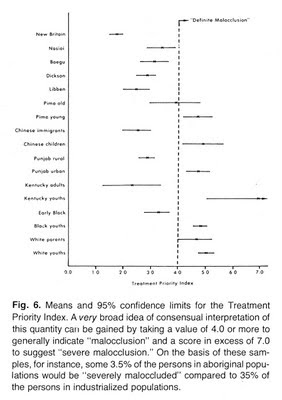 Every single urban/industrial culture has an average TPI of greater than 4, while all the non-industrial or less industrial cultures have an average TPI below 4. This means that in industrial cultures, the average person requires orthodontic treatment to achieve good occlusion, whereas most people in more traditionally-living cultures naturally have good occlusion.
The best occlusion was in the New Britain sample, a precontact Melanesian hunter-gatherer group studied from archaeological remains. The next best occlusion was in the Libben and Dickson groups, who were early Native American agriculturalists. The Pima represent the older generation of Native Americans that was raised on a somewhat traditional agricultural diet, vs. the younger generation raised on processed reservation foods. The Chinese samples are immigrants and their descendants in Liverpool. The Punjabis represent urban vs. rural youths in Northern India. The Kentucky samples represent a traditionally-living Appalachian community, older generation vs. processed food-eating offspring. The "early black" and "black youths" samples represent older and younger generations of African-Americans in the Cleveland and St. Louis area. The "white parents/youths" sample represents different generations of American Caucasians.
The point is clear: there's something about industrialization that causes malocclusion. It's not genetic; it's a result of changes in diet and/or lifestyle. A "disease of civilization". I use that phrase loosely, because malocclusion isn't really a disease, and some cultures that qualify as civilizations retain traditional foodways and relatively good teeth. Nevertheless, it's a time-honored phrase that encompasses the wide array of health problems that occur when humans stray too far from their ecological niche. I'm going to let Dr. Corruccini wrap this post up for me:
I assert that these results serve to modify two widespread generalizations: that imperfect occlusion is not necessarily abnormal, and that prevalence of malocclusion is genetically controlled so that preventive therapy in the strict sense is not possible. Cross-cultural data dispel the notion that considerable occlusal variation [malocclusion] is inevitable or normal. Rather, it is an aberrancy of modern urbanized populations. Furthermore, the transition from predominantly good to predominantly bad occlusion repeatedly occurs within one or two generations' time in these (and other) populations, weakening arguments that explain high malocclusion prevalence genetically.
* This paper is worth reading if you get the chance. It should have been a seminal paper in the field of preventive orthodontics, which could have largely replaced conventional orthodontics by now. Dr. Corruccini is the clearest thinker on this subject I've encountered so far.
In his epic work Nutrition and Physical Degeneration, Dr. Weston Price documented the abnormal dental development and susceptibility to tooth decay that accompanied the adoption of modern foods in a number of different cultures throughout the world. Although he quantified changes in cavity prevalence (sometimes finding increases as large as 1,000-fold), all we have are Price's anecdotes describing the crooked teeth, narrow arches and "dished" faces these cultures developed as they modernized.
Price published the first edition of his book in 1939. Fortunately, Nutrition and Physical Degeneration wasn't the last word on the matter. Anthropologists and archaeologists have been extending Price's findings throughout the 20th century. My favorite is Dr. Robert S. Corruccini, currently a professor of anthropology at Southern Illinois University. He published a landmark paper in 1984 titled "An Epidemiologic Transition in Dental Occlusion in World Populations" that will be our starting point for a discussion of how diet and lifestyle factors affect the development of the teeth, skull and jaw (Am J. Orthod. 86(5):419)*.
First, some background. The word occlusion refers to the manner in which the top and bottom sets of teeth come together, determined in part by the alignment between the upper jaw (maxilla) and lower jaw (mandible). There are three general categories: - Class I occlusion: considered "ideal". The bottom incisors (front teeth) fit just behind the top incisors.
- Class II occlusion: "overbite." The bottom incisors are too far behind the top incisors. The mandible may appear small.
- Class III occlusion: "underbite." The bottom incisors are beyond the top incisors. The mandible protrudes.
Malocclusion means the teeth do not come together in a way that's considered ideal. The term "class I malocclusion" is sometimes used to describe crowded incisors when the jaws are aligning properly.
Over the course of the next several posts, I'll give an overview of the extensive literature showing that hunter-gatherers past and present have excellent occlusion, subsistence agriculturalists generally have good occlusion, and the adoption of modern foodways directly causes the crooked teeth, narrow arches and/or crowded third molars (wisdom teeth) that affect the majority of people in industrialized nations. I believe this process also affects the development of the rest of the skull, including the face and sinuses. In his 1984 paper, Dr. Corruccini reviewed data from a number of cultures whose occlusion has been studied in detail. Most of these cultures were observed by Dr. Corruccini personally. He compared two sets of cultures: those that adhere to a traditional style of life and those that have adopted industrial foodways. For several of the cultures he studied, he compared it to another that was genetically similar. For example, the older generation of Pima indians vs. the younger generation, and rural vs. urban Punjabis. He also included data from archaeological sites and nonhuman primates. Wild animals, including nonhuman primates, almost invariably show perfect occlusion. The last graph in the paper is the most telling. He compiled all the occlusion data into a single number called the "treatment priority index" (TPI). This is a number that represents the overall need for orthodontic treatment. A TPI of 4 or greater indicates malocclusion (the cutoff point is subjective and depends somewhat on aesthetic considerations). Here's the graph: Every single urban/industrial culture has an average TPI of greater than 4, while all the non-industrial or less industrial cultures have an average TPI below 4. This means that in industrial cultures, the average person requires orthodontic treatment to achieve good occlusion, whereas most people in more traditionally-living cultures naturally have good occlusion.
The best occlusion was in the New Britain sample, a precontact Melanesian hunter-gatherer group studied from archaeological remains. The next best occlusion was in the Libben and Dickson groups, who were early Native American agriculturalists. The Pima represent the older generation of Native Americans that was raised on a somewhat traditional agricultural diet, vs. the younger generation raised on processed reservation foods. The Chinese samples are immigrants and their descendants in Liverpool. The Punjabis represent urban vs. rural youths in Northern India. The Kentucky samples represent a traditionally-living Appalachian community, older generation vs. processed food-eating offspring. The "early black" and "black youths" samples represent older and younger generations of African-Americans in the Cleveland and St. Louis area. The "white parents/youths" sample represents different generations of American Caucasians.
The point is clear: there's something about industrialization that causes malocclusion. It's not genetic; it's a result of changes in diet and/or lifestyle. A "disease of civilization". I use that phrase loosely, because malocclusion isn't really a disease, and some cultures that qualify as civilizations retain traditional foodways and relatively good teeth. Nevertheless, it's a time-honored phrase that encompasses the wide array of health problems that occur when humans stray too far from their ecological niche. I'm going to let Dr. Corruccini wrap this post up for me:
I assert that these results serve to modify two widespread generalizations: that imperfect occlusion is not necessarily abnormal, and that prevalence of malocclusion is genetically controlled so that preventive therapy in the strict sense is not possible. Cross-cultural data dispel the notion that considerable occlusal variation [malocclusion] is inevitable or normal. Rather, it is an aberrancy of modern urbanized populations. Furthermore, the transition from predominantly good to predominantly bad occlusion repeatedly occurs within one or two generations' time in these (and other) populations, weakening arguments that explain high malocclusion prevalence genetically.
* This paper is worth reading if you get the chance. It should have been a seminal paper in the field of preventive orthodontics, which could have largely replaced conventional orthodontics by now. Dr. Corruccini is the clearest thinker on this subject I've encountered so far.
In his epic work Nutrition and Physical Degeneration, Dr. Weston Price documented the abnormal dental development and susceptibility to tooth decay that accompanied the adoption of modern foods in a number of different cultures throughout the world. Although he quantified changes in cavity prevalence (sometimes finding increases as large as 1,000-fold), all we have are Price's anecdotes describing the crooked teeth, narrow arches and "dished" faces these cultures developed as they modernized.
Price published the first edition of his book in 1939. Fortunately, Nutrition and Physical Degeneration wasn't the last word on the matter. Anthropologists and archaeologists have been extending Price's findings throughout the 20th century. My favorite is Dr. Robert S. Corruccini, currently a professor of anthropology at Southern Illinois University. He published a landmark paper in 1984 titled "An Epidemiologic Transition in Dental Occlusion in World Populations" that will be our starting point for a discussion of how diet and lifestyle factors affect the development of the teeth, skull and jaw (Am J. Orthod. 86(5):419)*.
First, some background. The word occlusion refers to the manner in which the top and bottom sets of teeth come together, determined in part by the alignment between the upper jaw (maxilla) and lower jaw (mandible). There are three general categories: - Class I occlusion: considered "ideal". The bottom incisors (front teeth) fit just behind the top incisors.
- Class II occlusion: "overbite." The bottom incisors are too far behind the top incisors. The mandible may appear small.
- Class III occlusion: "underbite." The bottom incisors are beyond the top incisors. The mandible protrudes.
Malocclusion means the teeth do not come together in a way that's considered ideal. The term "class I malocclusion" is sometimes used to describe crowded incisors when the jaws are aligning properly.
Over the course of the next several posts, I'll give an overview of the extensive literature showing that hunter-gatherers past and present have excellent occlusion, subsistence agriculturalists generally have good occlusion, and the adoption of modern foodways directly causes the crooked teeth, narrow arches and/or crowded third molars (wisdom teeth) that affect the majority of people in industrialized nations. I believe this process also affects the development of the rest of the skull, including the face and sinuses. In his 1984 paper, Dr. Corruccini reviewed data from a number of cultures whose occlusion has been studied in detail. Most of these cultures were observed by Dr. Corruccini personally. He compared two sets of cultures: those that adhere to a traditional style of life and those that have adopted industrial foodways. For several of the cultures he studied, he compared it to another that was genetically similar. For example, the older generation of Pima indians vs. the younger generation, and rural vs. urban Punjabis. He also included data from archaeological sites and nonhuman primates. Wild animals, including nonhuman primates, almost invariably show perfect occlusion. The last graph in the paper is the most telling. He compiled all the occlusion data into a single number called the "treatment priority index" (TPI). This is a number that represents the overall need for orthodontic treatment. A TPI of 4 or greater indicates malocclusion (the cutoff point is subjective and depends somewhat on aesthetic considerations). Here's the graph: Every single urban/industrial culture has an average TPI of greater than 4, while all the non-industrial or less industrial cultures have an average TPI below 4. This means that in industrial cultures, the average person requires orthodontic treatment to achieve good occlusion, whereas most people in more traditionally-living cultures naturally have good occlusion.
The best occlusion was in the New Britain sample, a precontact Melanesian hunter-gatherer group studied from archaeological remains. The next best occlusion was in the Libben and Dickson groups, who were early Native American agriculturalists. The Pima represent the older generation of Native Americans that was raised on a somewhat traditional agricultural diet, vs. the younger generation raised on processed reservation foods. The Chinese samples are immigrants and their descendants in Liverpool. The Punjabis represent urban vs. rural youths in Northern India. The Kentucky samples represent a traditionally-living Appalachian community, older generation vs. processed food-eating offspring. The "early black" and "black youths" samples represent older and younger generations of African-Americans in the Cleveland and St. Louis area. The "white parents/youths" sample represents different generations of American Caucasians.
The point is clear: there's something about industrialization that causes malocclusion. It's not genetic; it's a result of changes in diet and/or lifestyle. A "disease of civilization". I use that phrase loosely, because malocclusion isn't really a disease, and some cultures that qualify as civilizations retain traditional foodways and relatively good teeth. Nevertheless, it's a time-honored phrase that encompasses the wide array of health problems that occur when humans stray too far from their ecological niche. I'm going to let Dr. Corruccini wrap this post up for me:
I assert that these results serve to modify two widespread generalizations: that imperfect occlusion is not necessarily abnormal, and that prevalence of malocclusion is genetically controlled so that preventive therapy in the strict sense is not possible. Cross-cultural data dispel the notion that considerable occlusal variation [malocclusion] is inevitable or normal. Rather, it is an aberrancy of modern urbanized populations. Furthermore, the transition from predominantly good to predominantly bad occlusion repeatedly occurs within one or two generations' time in these (and other) populations, weakening arguments that explain high malocclusion prevalence genetically.
* This paper is worth reading if you get the chance. It should have been a seminal paper in the field of preventive orthodontics, which could have largely replaced conventional orthodontics by now. Dr. Corruccini is the clearest thinker on this subject I've encountered so far.
In his epic work Nutrition and Physical Degeneration, Dr. Weston Price documented the abnormal dental development and susceptibility to tooth decay that accompanied the adoption of modern foods in a number of different cultures throughout the world. Although he quantified changes in cavity prevalence (sometimes finding increases as large as 1,000-fold), all we have are Price's anecdotes describing the crooked teeth, narrow arches and "dished" faces these cultures developed as they modernized.
Price published the first edition of his book in 1939. Fortunately, Nutrition and Physical Degeneration wasn't the last word on the matter. Anthropologists and archaeologists have been extending Price's findings throughout the 20th century. My favorite is Dr. Robert S. Corruccini, currently a professor of anthropology at Southern Illinois University. He published a landmark paper in 1984 titled "An Epidemiologic Transition in Dental Occlusion in World Populations" that will be our starting point for a discussion of how diet and lifestyle factors affect the development of the teeth, skull and jaw (Am J. Orthod. 86(5):419)*.
First, some background. The word occlusion refers to the manner in which the top and bottom sets of teeth come together, determined in part by the alignment between the upper jaw (maxilla) and lower jaw (mandible). There are three general categories: - Class I occlusion: considered "ideal". The bottom incisors (front teeth) fit just behind the top incisors.
- Class II occlusion: "overbite." The bottom incisors are too far behind the top incisors. The mandible may appear small.
- Class III occlusion: "underbite." The bottom incisors are beyond the top incisors. The mandible protrudes.
Malocclusion means the teeth do not come together in a way that's considered ideal. The term "class I malocclusion" is sometimes used to describe crowded incisors when the jaws are aligning properly.
Over the course of the next several posts, I'll give an overview of the extensive literature showing that hunter-gatherers past and present have excellent occlusion, subsistence agriculturalists generally have good occlusion, and the adoption of modern foodways directly causes the crooked teeth, narrow arches and/or crowded third molars (wisdom teeth) that affect the majority of people in industrialized nations. I believe this process also affects the development of the rest of the skull, including the face and sinuses. In his 1984 paper, Dr. Corruccini reviewed data from a number of cultures whose occlusion has been studied in detail. Most of these cultures were observed by Dr. Corruccini personally. He compared two sets of cultures: those that adhere to a traditional style of life and those that have adopted industrial foodways. For several of the cultures he studied, he compared it to another that was genetically similar. For example, the older generation of Pima indians vs. the younger generation, and rural vs. urban Punjabis. He also included data from archaeological sites and nonhuman primates. Wild animals, including nonhuman primates, almost invariably show perfect occlusion. The last graph in the paper is the most telling. He compiled all the occlusion data into a single number called the "treatment priority index" (TPI). This is a number that represents the overall need for orthodontic treatment. A TPI of 4 or greater indicates malocclusion (the cutoff point is subjective and depends somewhat on aesthetic considerations). Here's the graph: Every single urban/industrial culture has an average TPI of greater than 4, while all the non-industrial or less industrial cultures have an average TPI below 4. This means that in industrial cultures, the average person requires orthodontic treatment to achieve good occlusion, whereas most people in more traditionally-living cultures naturally have good occlusion.
The best occlusion was in the New Britain sample, a precontact Melanesian hunter-gatherer group studied from archaeological remains. The next best occlusion was in the Libben and Dickson groups, who were early Native American agriculturalists. The Pima represent the older generation of Native Americans that was raised on a somewhat traditional agricultural diet, vs. the younger generation raised on processed reservation foods. The Chinese samples are immigrants and their descendants in Liverpool. The Punjabis represent urban vs. rural youths in Northern India. The Kentucky samples represent a traditionally-living Appalachian community, older generation vs. processed food-eating offspring. The "early black" and "black youths" samples represent older and younger generations of African-Americans in the Cleveland and St. Louis area. The "white parents/youths" sample represents different generations of American Caucasians.
The point is clear: there's something about industrialization that causes malocclusion. It's not genetic; it's a result of changes in diet and/or lifestyle. A "disease of civilization". I use that phrase loosely, because malocclusion isn't really a disease, and some cultures that qualify as civilizations retain traditional foodways and relatively good teeth. Nevertheless, it's a time-honored phrase that encompasses the wide array of health problems that occur when humans stray too far from their ecological niche. I'm going to let Dr. Corruccini wrap this post up for me:
I assert that these results serve to modify two widespread generalizations: that imperfect occlusion is not necessarily abnormal, and that prevalence of malocclusion is genetically controlled so that preventive therapy in the strict sense is not possible. Cross-cultural data dispel the notion that considerable occlusal variation [malocclusion] is inevitable or normal. Rather, it is an aberrancy of modern urbanized populations. Furthermore, the transition from predominantly good to predominantly bad occlusion repeatedly occurs within one or two generations' time in these (and other) populations, weakening arguments that explain high malocclusion prevalence genetically.
* This paper is worth reading if you get the chance. It should have been a seminal paper in the field of preventive orthodontics, which could have largely replaced conventional orthodontics by now. Dr. Corruccini is the clearest thinker on this subject I've encountered so far.
In April of 1982, archaeologists from around the globe converged on Plattsburgh, New York for a research symposium. Their goal:...[to use] data from human skeletal analysis and paleopathology [the study of ancient diseases] to measure the impact on human health of the Neolithic Revolution and antecedent changes in prehistoric hunter-gatherer food economies. The symposium developed out of our perception that many widely debated theories about the origins of agriculture had testable but untested implications concerning human health and nutrition and our belief that recent advances in techniques of skeletal analysis, and the recent explosive increase in data available in this field, permitted valid tests of many of these propositions.
In other words, they got together to see what happened to human health as populations adopted agriculture. They were kind enough to publish the data presented at the symposium in the book Paleopathology at the Origins of Agriculture, edited by the erudite Drs. Mark Nathan Cohen and George J. Armelagos. It appears to be out of print, but luckily I have access to an excellent university library.There are some major limitations to studying human health by looking at bones. The most obvious is that any soft tissue pathology will have been erased by time. Nevertheless, you can learn a lot from a skeleton. Here are the main health indicators discussed in the book:- Mortality. Archaeologists are able to judge a person's approximate age at death, and if the number of skeletons is large enough, they can paint a rough picture of the life expectancy and infant mortality of a population.
- General growth. Total height, bone thickness, dental crowding, and pelvic and skull shape are all indicators of relative nutrition and health. This is particularly true in a genetically stable population. Pelvic depth is sensitive to nutrition and determines the size of the birth canal in women.
- Episodic stress. Bones and teeth carry markers of temporary "stress", most often due to starvation or malnutrition. Enamel hypoplasia, horizontal bands of thinned enamel on the teeth, is probably the most reliable marker. Harris lines, bands of increased density in long bones that may be caused by temporary growth arrest, are another type.
- Porotic hyperostosis and cribra orbitalia. These are both skull deformities that are caused by iron deficiency anemia, and are rather creepy to look at. They're typically caused by malnutrition, but can also result from parasites.
- Periosteal reactions. These are bone lesions resulting from infections.
- Physical trauma, such as fractures.
- Degenerative bone conditions, such as arthritis.
- Isotopes and trace elements. These can sometimes yield information about the nutritional status, diet composition and diet quality of populations.
- Dental pathology. My favorite! This category includes cavities, periodontal disease, missing teeth, abscesses, tooth wear, and excessive dental plaque.
The book presents data from 19 regions of the globe, representing Africa, Asia, the Middle East, Europe, South America, with a particular focus on North America. I'll kick things off with a fairly representative description of health in the upper Paleolithic in the Eastern Mediterranean. The term "Paleolithic" refers to the period from the invention of stone tools by hominids 2.5 million years ago, to the invention of agriculture roughly 10,000 years ago. The upper Paleolithic lasted from about 40,000 to 10,000 years ago. From page 59:In Upper Paleolithic times nutritional health was excellent. The evidence consists of extremely tall stature from plentiful calories and protein (and some microevolutionary selection?); maximum skull base height from plentiful protein, vitamin D, and sunlight in early childhood; and very good teeth and large pelvic depth from adequate protein and vitamins in later childhood and adolescence...
Adult longevity, at 35 years for males and 30 years for females, implies fair to good general health...
There is no clear evidence for any endemic disease.
The level of skeletal (including cranial and pelvic) development Paleolithic groups exhibited has remained unmatched throughout the history of agriculture. There may be exceptions but the trend is clear. Cranial capacity was 11% higher in the upper Paleolithic. You can see the pelvic data in this table taken from Paleopathology at the Origins of Agriculture. There's so much information in this book, the best I can do is quote pieces of the editor's summary and add a few remarks of my own. One of the most interesting things I learned from the book is that the diet of many hunter-gatherer groups changed at the end of the upper Paleolithic, foreshadowing the shift to agriculture. From pages 566-568: During the upper Paleolithic stage, subsistence seems focused on relatively easily available foods of high nutritional value, such as large herd animals and migratory fish. Some plant foods seem to have been eaten, but they appear not to have been quantitatively important in the diet. Storage of foods appears early in many sequences, even during the Paleolithic, apparently to save seasonal surpluses for consumption during seasons of low productivity.
As hunting and gathering economies evolve during the Mesolithic [period of transition between hunting/gathering and agriculture], subsistence is expanded by exploitation of increasing numbers of species and by increasingly heavy exploitation of the more abundant and productive plant species. The inclusion of significant amounts of plant food in prehistoric diets seems to correlate with increased use of food processing tools, apparently to improve their taste and digestibility. As [Dr. Mark Nathan] Cohen suggests, there is an increasing focus through time on a few starchy plants of high productivity and storability. This process of subsistence intensification occurs even in regions where native agriculture never developed. In California, for example, as hunting-gathering populations grew, subsistence changed from an early pattern of reliance on game and varied plant resources to to one with increasing emphasis on collection of a few species of starchy seeds and nuts.
...As [Dr. Cohen] predicts, evolutionary change in prehistoric subsistence has moved in the direction of higher carrying capacity foods, not toward foods of higher-quality nutrition or greater reliability. Early nonagricultural diets appear to have been high in minerals, protein, vitamins, and trace nutrients, but relatively low in starch. In the development toward agriculture there is a growing emphasis on starchy, highly caloric food of high productivity and storability, changes that are not favorable to nutritional quality but that would have acted to increase carrying capacity, as Cohen's theory suggests.
Why am I getting the feeling that these archaeologists have a better grasp of human nutrition than the average medical doctor or nutritionist? They have the Price-esque understanding that comes from comparing the diets and multi-generational health of diverse human populations.One of the interesting things I learned from the book is that Mesolithic populations, groups that were halfway between farming and hunting-gathering, were generally as healthy as hunter-gatherers: ...it seems clear that seasonal and periodic physiological stress regularly affected most prehistoric hunting-gathering populations, as evidenced by the presence of enamel hypoplasias and Harris lines. What also seems clear is that severe and chronic stress, with high frequency of hypoplasias, infectious disease lesions, pathologies related to iron-deficiency anemia, and high mortality rates, is not characteristic of these early populations. There is no evidence of frequent, severe malnutrition, so the diet must have been adequate in calories and other nutrients most of the time. During the Mesolithic, the proportion of starch in the diet rose, to judge from the increased occurrence of certain dental diseases [with exceptions to be noted later], but not enough to create an impoverished diet... There is a possible slight tendency for Paleolithic people to be healthier and taller than Mesolithic people, but there is no apparent trend toward increasing physiological stress during the mesolithic.
Cultures that adopted intensive agriculture typically showed a marked decline in health indicators. This is particularly true of dental health, which usually became quite poor.Stress, however, does not seem to have become common and widespread until after the development of high degrees of sedentism, population density, and reliance on intensive agriculture. At this stage in all regions the incidence of physiological stress increases greatly, and average mortality rates increase appreciably. Most of these agricultural populations have high frequencies of porotic hyperostosis and cribra orbitalia, and there is a substantial increase in the number and severity of enamel hypoplasias and pathologies associated with infectious disease. Stature in many populations appears to have been considerably lower than would be expected if genetically-determined maxima had been reached, which suggests that the growth arrests documented by pathologies were causing stunting... Incidence of carbohydrate-related tooth disease increases, apparently because subsistence by this time is characterized by a heavy emphasis on a few starchy food crops.
Infectious disease increased upon agricultural intensification:Most [studies] conclude that infection was a more common and more serious problem for farmers than for their hunting and gathering forebears; and most suggest that this resulted from some combination of increasing sedentism, larger population aggregates, and the well-established synergism between infection and malnutrition.
There are some apparent exceptions to the trend of declining health with the adoption of intensive agriculture. In my observation, they fall into two general categories. In the first, health improves upon the transition to agriculture because the hunter-gatherer population was unhealthy to begin with. This is due to living in a marginal environment or eating a diet with a high proportion of wild plant seeds. In the second category, the culture adopted rice. Rice is associated with less of a decline in health, and in some cases an increase in overall health, than other grains such as wheat and corn. In chapter 21 of the book Ancient Health: Bioarchaeological Interpretations of the Human Past, Drs. Michelle T Douglas and Michael Pietrusewsky state that "rice appears to be less cariogenic [cavity-promoting] than other grains such as maize [corn]."One pathology that seems to have decreased with the adoption of agriculture is arthritis. The authors speculate that it may have more to do with strenuous activity than other aspects of the lifestyle such as diet. Another interpretation is that the hunter-gatherers appeared to have a higher arthritis rate because of their longer lifespans:The arthritis data are also complicated by the fact that the hunter-gatherers discussed commonly displayed higher average ages at death than did the farming populations from the same region. The hunter-gatherers would therefore be expected to display more arthritis as a function of age even if their workloads were comparable [to farmers].
In any case, it appears arthritis is normal for human beings and not a modern degenerative disease. And the final word:Taken as a whole, these indicators fairly clearly suggest an overall decline in the quality-- and probably in the length-- of human life associated with the adoption of agriculture.
In April of 1982, archaeologists from around the globe converged on Plattsburgh, New York for a research symposium. Their goal:...[to use] data from human skeletal analysis and paleopathology [the study of ancient diseases] to measure the impact on human health of the Neolithic Revolution and antecedent changes in prehistoric hunter-gatherer food economies. The symposium developed out of our perception that many widely debated theories about the origins of agriculture had testable but untested implications concerning human health and nutrition and our belief that recent advances in techniques of skeletal analysis, and the recent explosive increase in data available in this field, permitted valid tests of many of these propositions.
In other words, they got together to see what happened to human health as populations adopted agriculture. They were kind enough to publish the data presented at the symposium in the book Paleopathology at the Origins of Agriculture, edited by the erudite Drs. Mark Nathan Cohen and George J. Armelagos. It appears to be out of print, but luckily I have access to an excellent university library.There are some major limitations to studying human health by looking at bones. The most obvious is that any soft tissue pathology will have been erased by time. Nevertheless, you can learn a lot from a skeleton. Here are the main health indicators discussed in the book:- Mortality. Archaeologists are able to judge a person's approximate age at death, and if the number of skeletons is large enough, they can paint a rough picture of the life expectancy and infant mortality of a population.
- General growth. Total height, bone thickness, dental crowding, and pelvic and skull shape are all indicators of relative nutrition and health. This is particularly true in a genetically stable population. Pelvic depth is sensitive to nutrition and determines the size of the birth canal in women.
- Episodic stress. Bones and teeth carry markers of temporary "stress", most often due to starvation or malnutrition. Enamel hypoplasia, horizontal bands of thinned enamel on the teeth, is probably the most reliable marker. Harris lines, bands of increased density in long bones that may be caused by temporary growth arrest, are another type.
- Porotic hyperostosis and cribra orbitalia. These are both skull deformities that are caused by iron deficiency anemia, and are rather creepy to look at. They're typically caused by malnutrition, but can also result from parasites.
- Periosteal reactions. These are bone lesions resulting from infections.
- Physical trauma, such as fractures.
- Degenerative bone conditions, such as arthritis.
- Isotopes and trace elements. These can sometimes yield information about the nutritional status, diet composition and diet quality of populations.
- Dental pathology. My favorite! This category includes cavities, periodontal disease, missing teeth, abscesses, tooth wear, and excessive dental plaque.
The book presents data from 19 regions of the globe, representing Africa, Asia, the Middle East, Europe, South America, with a particular focus on North America. I'll kick things off with a fairly representative description of health in the upper Paleolithic in the Eastern Mediterranean. The term "Paleolithic" refers to the period from the invention of stone tools by hominids 2.5 million years ago, to the invention of agriculture roughly 10,000 years ago. The upper Paleolithic lasted from about 40,000 to 10,000 years ago. From page 59:In Upper Paleolithic times nutritional health was excellent. The evidence consists of extremely tall stature from plentiful calories and protein (and some microevolutionary selection?); maximum skull base height from plentiful protein, vitamin D, and sunlight in early childhood; and very good teeth and large pelvic depth from adequate protein and vitamins in later childhood and adolescence...
Adult longevity, at 35 years for males and 30 years for females, implies fair to good general health...
There is no clear evidence for any endemic disease.
The level of skeletal (including cranial and pelvic) development Paleolithic groups exhibited has remained unmatched throughout the history of agriculture. There may be exceptions but the trend is clear. Cranial capacity was 11% higher in the upper Paleolithic. You can see the pelvic data in this table taken from Paleopathology at the Origins of Agriculture. There's so much information in this book, the best I can do is quote pieces of the editor's summary and add a few remarks of my own. One of the most interesting things I learned from the book is that the diet of many hunter-gatherer groups changed at the end of the upper Paleolithic, foreshadowing the shift to agriculture. From pages 566-568: During the upper Paleolithic stage, subsistence seems focused on relatively easily available foods of high nutritional value, such as large herd animals and migratory fish. Some plant foods seem to have been eaten, but they appear not to have been quantitatively important in the diet. Storage of foods appears early in many sequences, even during the Paleolithic, apparently to save seasonal surpluses for consumption during seasons of low productivity.
As hunting and gathering economies evolve during the Mesolithic [period of transition between hunting/gathering and agriculture], subsistence is expanded by exploitation of increasing numbers of species and by increasingly heavy exploitation of the more abundant and productive plant species. The inclusion of significant amounts of plant food in prehistoric diets seems to correlate with increased use of food processing tools, apparently to improve their taste and digestibility. As [Dr. Mark Nathan] Cohen suggests, there is an increasing focus through time on a few starchy plants of high productivity and storability. This process of subsistence intensification occurs even in regions where native agriculture never developed. In California, for example, as hunting-gathering populations grew, subsistence changed from an early pattern of reliance on game and varied plant resources to to one with increasing emphasis on collection of a few species of starchy seeds and nuts.
...As [Dr. Cohen] predicts, evolutionary change in prehistoric subsistence has moved in the direction of higher carrying capacity foods, not toward foods of higher-quality nutrition or greater reliability. Early nonagricultural diets appear to have been high in minerals, protein, vitamins, and trace nutrients, but relatively low in starch. In the development toward agriculture there is a growing emphasis on starchy, highly caloric food of high productivity and storability, changes that are not favorable to nutritional quality but that would have acted to increase carrying capacity, as Cohen's theory suggests.
Why am I getting the feeling that these archaeologists have a better grasp of human nutrition than the average medical doctor or nutritionist? They have the Price-esque understanding that comes from comparing the diets and multi-generational health of diverse human populations.One of the interesting things I learned from the book is that Mesolithic populations, groups that were halfway between farming and hunting-gathering, were generally as healthy as hunter-gatherers: ...it seems clear that seasonal and periodic physiological stress regularly affected most prehistoric hunting-gathering populations, as evidenced by the presence of enamel hypoplasias and Harris lines. What also seems clear is that severe and chronic stress, with high frequency of hypoplasias, infectious disease lesions, pathologies related to iron-deficiency anemia, and high mortality rates, is not characteristic of these early populations. There is no evidence of frequent, severe malnutrition, so the diet must have been adequate in calories and other nutrients most of the time. During the Mesolithic, the proportion of starch in the diet rose, to judge from the increased occurrence of certain dental diseases [with exceptions to be noted later], but not enough to create an impoverished diet... There is a possible slight tendency for Paleolithic people to be healthier and taller than Mesolithic people, but there is no apparent trend toward increasing physiological stress during the mesolithic.
Cultures that adopted intensive agriculture typically showed a marked decline in health indicators. This is particularly true of dental health, which usually became quite poor.Stress, however, does not seem to have become common and widespread until after the development of high degrees of sedentism, population density, and reliance on intensive agriculture. At this stage in all regions the incidence of physiological stress increases greatly, and average mortality rates increase appreciably. Most of these agricultural populations have high frequencies of porotic hyperostosis and cribra orbitalia, and there is a substantial increase in the number and severity of enamel hypoplasias and pathologies associated with infectious disease. Stature in many populations appears to have been considerably lower than would be expected if genetically-determined maxima had been reached, which suggests that the growth arrests documented by pathologies were causing stunting... Incidence of carbohydrate-related tooth disease increases, apparently because subsistence by this time is characterized by a heavy emphasis on a few starchy food crops.
Infectious disease increased upon agricultural intensification:Most [studies] conclude that infection was a more common and more serious problem for farmers than for their hunting and gathering forebears; and most suggest that this resulted from some combination of increasing sedentism, larger population aggregates, and the well-established synergism between infection and malnutrition.
There are some apparent exceptions to the trend of declining health with the adoption of intensive agriculture. In my observation, they fall into two general categories. In the first, health improves upon the transition to agriculture because the hunter-gatherer population was unhealthy to begin with. This is due to living in a marginal environment or eating a diet with a high proportion of wild plant seeds. In the second category, the culture adopted rice. Rice is associated with less of a decline in health, and in some cases an increase in overall health, than other grains such as wheat and corn. In chapter 21 of the book Ancient Health: Bioarchaeological Interpretations of the Human Past, Drs. Michelle T Douglas and Michael Pietrusewsky state that "rice appears to be less cariogenic [cavity-promoting] than other grains such as maize [corn]."One pathology that seems to have decreased with the adoption of agriculture is arthritis. The authors speculate that it may have more to do with strenuous activity than other aspects of the lifestyle such as diet. Another interpretation is that the hunter-gatherers appeared to have a higher arthritis rate because of their longer lifespans:The arthritis data are also complicated by the fact that the hunter-gatherers discussed commonly displayed higher average ages at death than did the farming populations from the same region. The hunter-gatherers would therefore be expected to display more arthritis as a function of age even if their workloads were comparable [to farmers].
In any case, it appears arthritis is normal for human beings and not a modern degenerative disease. And the final word:Taken as a whole, these indicators fairly clearly suggest an overall decline in the quality-- and probably in the length-- of human life associated with the adoption of agriculture.


